Publised on Sep 1, 2025
Annual Return Filing in Singapore: A Simple Guide for Business Owners

Hannah Poh
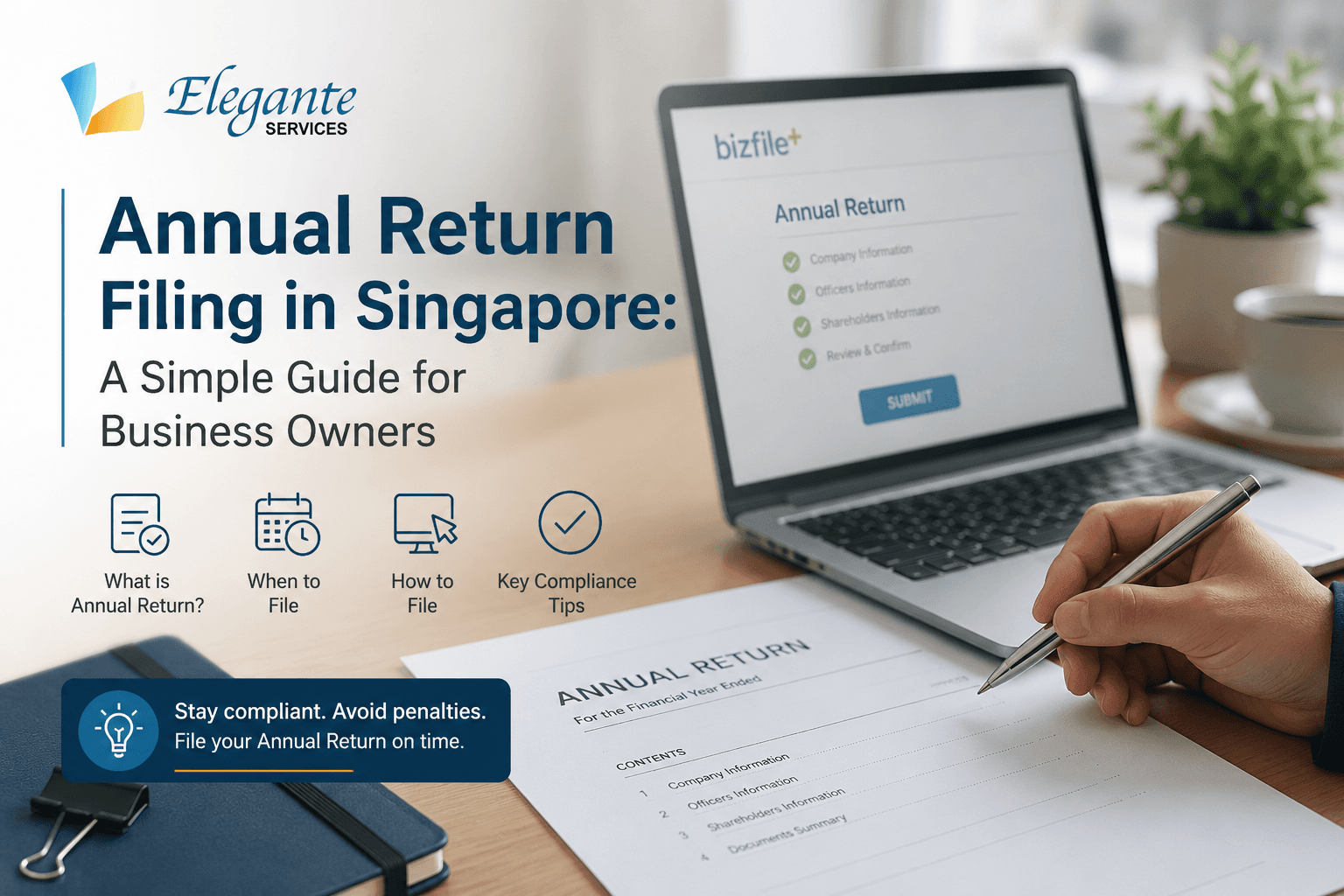
Annual Return Filing in Singapore: A Simple Guide for Business Owners
Annual return filing is one of the most important recurring compliance duties for Singapore companies.
Many business owners hear about “annual return filing” only when their company secretary reminds them near the deadline. However, it is useful to understand what this filing is, why it matters, and what information needs to be prepared.
ACRA states that all companies in Singapore must file annual returns on time, and late filing may result in penalties of up to $600. The filing deadline depends on the company type and the company’s financial year end.
For business owners who prefer to focus on operations and growth, having proper corporate secretarial services in Singapore can help ensure that annual return filing and other statutory obligations are better managed.
What Is an Annual Return?
An annual return is a yearly filing submitted to ACRA.
It updates ACRA on key company information, including details about the company’s officers, shareholders, registered office, financial year end and annual filing status.
The annual return is not the same as a tax return. Annual return filing is submitted to ACRA, while corporate income tax filing is submitted to IRAS.
Both are important, but they serve different purposes.
Annual return filing helps keep the company’s official records updated, while tax filing helps IRAS assess the company’s tax position.
This is why company owners should not confuse ACRA compliance support with corporate tax filing coordination. Both may be needed as part of proper company administration.
Why Annual Return Filing Matters
Annual return filing is not just paperwork.
It helps maintain the company’s statutory compliance and keeps company information properly updated with ACRA.
For business owners, timely annual return filing can support:
Better corporate governance
Cleaner company records
Better credibility with banks and vendors
Smoother financing applications
Better readiness for investor or partner due diligence
Reduced risk of penalties and enforcement issues
If your company is applying for bank facilities, tendering for projects, entering contracts or dealing with larger clients, proper compliance records can help support business credibility.
This is especially important for project-based businesses, including consultants, renovation firms, builders and a landed house contractor in Singapore, where clients and partners may expect the business to be properly organised and professionally managed.
When Must Singapore Companies File Annual Returns?
The annual return filing deadline depends on the company type and the company’s financial year end.
ACRA states that annual return filing deadlines depend on the company type and FYE. Companies must file annual returns on time to avoid penalties.
In general, business owners should know:
The company’s financial year end
Whether the company needs to hold an AGM
Whether the company is exempt from holding an AGM
When the annual return is due
Whether financial statements need to be prepared
Whether XBRL filing applies
Do not wait until the annual return deadline to check these matters.
A practical approach is to review your company’s annual compliance position shortly after the financial year end.
Elegante can support business owners with annual compliance reminders so that important filing dates are tracked more systematically.
How AGM Requirements Affect Annual Return Filing
Annual return filing is closely connected to AGM requirements.
An Annual General Meeting, or AGM, is where the company presents its accounts to shareholders.
ACRA states that companies must generally hold AGMs within four to six months of their financial year end to present their accounts to shareholders.
Some private companies may be exempt from holding an AGM if they meet the relevant conditions. However, this does not automatically mean that there is nothing to file.
When filing an annual return, companies must declare their AGM details. ACRA states that this applies whether the company held an AGM, was exempt, or dispensed with holding an AGM.
This is a common area where small companies become confused.
For example, a business owner may think:
“My company is small, so I do not need to do anything.”
That may not be correct.
Even a small company may still need to maintain proper records, prepare the necessary documents and file its annual return.
What Information Is Usually Needed?
Before filing an annual return, business owners should ensure that the company’s key information is accurate.
This may include:
Company name
Company registration number
Registered office address
Principal business activity
Details of directors
Details of company secretary
Shareholder information
Share capital information
Financial year end
AGM status
Financial statement status, where applicable
If company information has changed during the year, it should be reviewed before annual return filing.
For example, if the company changed its registered office address, appointed a new director or changed its business activity, those details should be properly updated.
This is where ongoing business administration support can help business owners avoid last-minute confusion.
Do Dormant Companies Need to File Annual Returns?
Business owners should be careful not to assume that dormant companies have no filing obligations.
A company that has stopped trading, has no revenue or has no active operations may still need to file annual returns with ACRA.
Dormant or inactive companies may also still have tax filing obligations with IRAS, depending on the circumstances.
This is why business owners should review both ACRA and IRAS obligations instead of assuming that “inactive” means “nothing to do”.
For a broader overview, you may also read our guide on Corporate Income Tax Filing 2026.
Can You Apply for an Extension of Time?
If a company cannot meet its annual return filing deadline, it may be possible to apply for an extension of time.
ACRA states that companies may apply for a 60-day extension to file annual returns, and each application costs $200.
However, business owners should not treat extensions as a routine solution.
It is usually better to maintain proper records and prepare early, instead of repeatedly relying on extensions.
Late filing can still create administrative pressure and unnecessary cost.
What Happens If You File Late?
Late annual return filing can lead to penalties and enforcement issues.
ACRA states that all Singapore companies must file annual returns on time to avoid penalties of up to $600.
ACRA may also take more serious enforcement action for late annual return filing. In some situations, ACRA may offer a composition sum instead of court prosecution, and a late AGM may also lead to annual return filing breaches.
For business owners, the practical message is simple:
Do not leave annual filing matters until the last minute.
Late filing may seem like a small administrative issue, but it can affect how organised and credible your company appears to stakeholders.
Annual Return Filing and Accounting Records
Annual return filing may require financial information, depending on your company’s situation.
Even if your company qualifies for certain exemptions, you should still maintain proper accounting records.
Good records help with:
Annual return filing
Financial statement preparation
Corporate tax filing
GST matters, where applicable
Payroll reporting
Business planning
Loan or financing applications
Investor due diligence
For SMEs, proper accounting services in Singapore can help keep company records organised throughout the year.
This is especially useful when annual filing, tax filing and payroll records are all connected.
Company Name Registration Is Not the Same as Trademark Protection
Many business owners assume that once they register a company name with ACRA, the brand name is fully protected.
This is a common misunderstanding.
Company name registration and trademark protection serve different purposes.
ACRA registration allows the company to exist as a legal entity under that name, but it does not necessarily give the business the same type of brand protection as a registered trademark.
If your company name, logo, product name or service brand is important to your business, you may wish to consider trademark registration in Singapore as part of your wider business planning.
This is especially relevant for businesses that are investing in:
Brand identity
Website development
Social media marketing
Advertising
Franchise planning
Product launches
Regional expansion
For SMEs, compliance helps keep the company properly administered. Brand protection helps protect the value that the business is building.
Annual Return Filing Checklist for Business Owners
Use this simple checklist:
Confirm your company’s financial year end
Check whether AGM is required
Check whether your company is exempt from AGM
Prepare or review financial statements, where applicable
Confirm company officer details
Confirm shareholder information
Confirm registered office address
Review business activity details
Check whether any company changes need to be updated
Prepare annual return information
File before the deadline
Keep records after filing
Related Guides for Singapore Business Owners
Annual return filing should be viewed together with wider company compliance and business planning.
You may also find these guides useful:
Business owners may also wish to review wider business protection and industry-specific planning. Growing SMEs can consider trademark registration in Singapore to protect their brand identity, while project-based businesses such as builders, renovation firms and a landed house contractor in Singapore should maintain proper records for project cost, manpower planning and business credibility.
How Elegante Can Help
Elegante supports SMEs with business administration and compliance coordination.
Our services may include:
Instead of dealing with compliance only when deadlines are near, business owners can work with Elegante to keep company records and recurring filing matters organised throughout the year.
Contact Elegante Services to discuss your company’s annual compliance needs.
Disclaimer
This article is for general information only and should not be treated as legal, accounting, tax, payroll or financial advice. Business owners should refer to ACRA, IRAS, CPF Board or consult a qualified professional for advice specific to their company.