Publised on Sep 27, 2025
Corporate Income Tax Filing 2026 Singapore: Key Deadlines

Hannah Poh
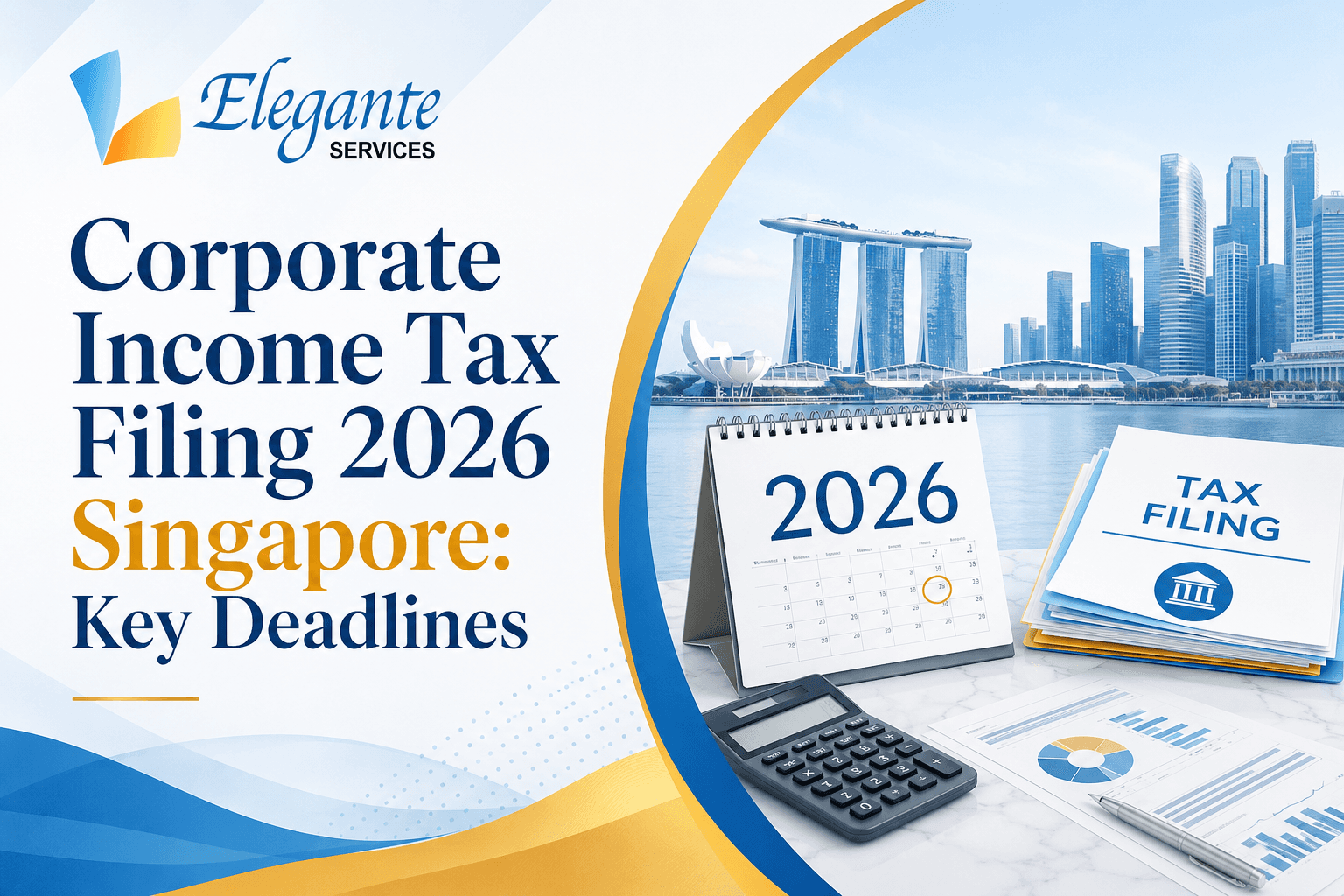
Corporate Income Tax Filing 2026: Key Deadlines for Singapore Companies
Corporate Income Tax filing is one of the most important annual obligations for Singapore companies.
Whether your company is profitable, loss-making, active or inactive, business owners should understand the relevant filing deadlines and prepare early.
For Year of Assessment 2026, IRAS states that all companies must file their Corporate Income Tax Return by 30 November 2026 through myTax Portal. This includes companies that did not carry on business or incurred a loss in financial year 2025.
For business owners, the key message is simple: do not assume that no profit means no filing.
If you need help coordinating your company’s tax filing preparation, Elegante can assist with corporate tax filing coordination.
What Is Corporate Income Tax Filing?
Corporate Income Tax filing is the process where a company declares its income, expenses and taxable position to IRAS.
In Singapore, companies generally file one of the following:
Form C-S
Form C-S Lite
Form C
The appropriate form depends on the company’s situation and whether it meets the conditions for simplified filing.
Corporate tax filing is not just about submitting a form. It usually requires proper accounting records, financial statements, tax computation and supporting documents.
This is why many SME owners choose to maintain proper bookkeeping and accounting coordination throughout the year instead of rushing during tax season.
Key Deadline for YA 2026
The key deadline for YA 2026 Corporate Income Tax Return filing is:
30 November 2026
IRAS states that all companies must file their YA 2026 Corporate Income Tax Return by this deadline.
Business owners should not wait until November to prepare. If your accounts are not updated, you may need time to organise invoices, expenses, bank statements, payroll records and supporting documents.
What About Estimated Chargeable Income?
Estimated Chargeable Income, or ECI, is an estimate of a company’s taxable income for a Year of Assessment.
For many companies, ECI filing is generally due within three months from the end of the company’s financial year, unless the company qualifies for a filing waiver or is not required to file.
For example:
Company with 31 December financial year end: ECI generally due by 31 March
Company with 31 March financial year end: ECI generally due by 30 June
Company with 30 June financial year end: ECI generally due by 30 September
Company with 30 September financial year end: ECI generally due by 31 December
This is why knowing your company’s financial year end is very important.
Elegante can help business owners organise company administration support so that key financial and filing dates are not overlooked.
Companies That Must Still Pay Attention
Corporate Income Tax filing is relevant even if your company:
Made a loss
Had no business activity
Is newly incorporated
Is dormant
Has not started trading
Has low revenue
Has only one shareholder
Is owner-managed
A common mistake among small business owners is assuming that no tax payable means no filing required.
IRAS states that all companies must file their YA 2026 Corporate Income Tax Return by 30 November 2026, including companies that did not carry on business or incurred a loss in financial year 2025.
What Business Owners Should Prepare
To prepare for Corporate Income Tax filing, business owners should organise:
Profit and loss statement
Balance sheet
General ledger
Bank statements
Sales invoices
Expense receipts
Payroll records
CPF contribution records
Director fee records, if applicable
Loan agreements, if applicable
Fixed asset records
Tax computation
Supporting schedules
If your records are messy, tax filing becomes more difficult and may result in delays or errors.
A practical approach is to update accounts monthly or quarterly instead of waiting until the filing deadline.
Why Proper Bookkeeping Matters
Corporate tax filing depends heavily on proper bookkeeping.
Without clean records, business owners may struggle to determine:
Revenue earned
Deductible expenses
Non-deductible expenses
Capital allowances
Director and shareholder transactions
GST position, if applicable
Actual taxable income
For SMEs, proper bookkeeping is not only for tax filing. It also helps business owners understand profitability, cash flow and business performance.
Elegante can support business owners with accounting services in Singapore so that tax season becomes more manageable.
Watch Out for These Common Mistakes
Many SMEs run into problems because of simple mistakes.
Common issues include:
Waiting until the last month to prepare accounts
Mixing personal and business expenses
Losing receipts
Not tracking director and shareholder advances
Forgetting CPF and payroll records
Assuming inactive companies do not need filing
Not checking ECI obligations
Missing the 30 November deadline
Filing figures without proper supporting records
Many of these issues can be avoided with better business administration support and earlier planning.
Corporate Income Tax Filing 2026 Checklist
Before filing, check the following:
Is your accounting completed?
Are bank reconciliations done?
Are sales and expenses properly recorded?
Are payroll and CPF records available?
Are director and shareholder transactions reviewed?
Is ECI filing required?
Which tax form should the company file?
Is the 30 November 2026 deadline noted?
Are supporting documents properly saved?
Related 2026 Compliance Guides
Corporate tax filing should be viewed together with your company’s wider compliance obligations. You may also find our ACRA Compliance Checklist 2026 and Singapore Budget 2026 tax updates for SMEs useful.
How Elegante Can Help
Elegante helps business owners coordinate company administration, accounting and tax filing preparation.
Our support may include:
If you want to avoid last-minute tax filing pressure, contact Elegante Services to discuss your company’s compliance needs.
Disclaimer
This article is for general information only and should not be treated as tax, legal, accounting or financial advice. Business owners should refer to IRAS or consult a qualified tax professional for advice specific to their company.